Trump’s 28 Point Peace Plan for Ending the Russia-Ukraine Proxy War
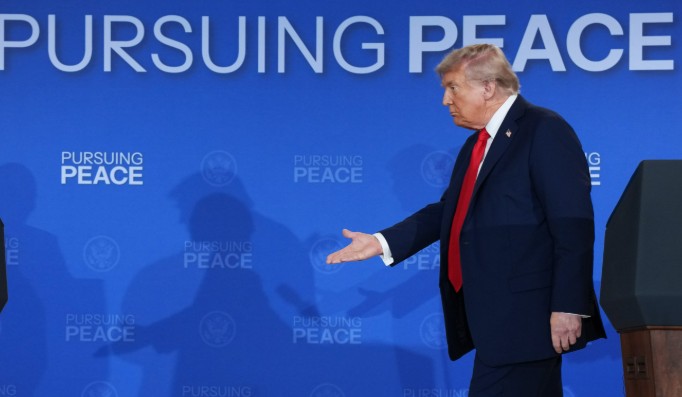
President Trump has promulgated a 28-point plan for peace in Ukraine. This plan has sparked much debate, and among the primary reasons is that the plan would force Kyiv to give up additional territory in the east, cap the size of its military, and agree it will never join NATO. However, despite the debate surrounding it, this 28 point peace plan remains crucial in discourse about ending the conflict involving Russia and Ukraine, and it remains crucial because the US is not only pushing Ukraine to make a deal on an “aggressive timeline” (which is necessary) – but also because despite the plan including proposals Ukraine has repeatedly rejected up to now, President Volodymyr Zelensky is not ruling it out.
THE CONTEXTUAL BACKGROUND OF THE MAKING OF THE 28-POINT PEACE PLAN
President Trump’s 28 point peace plan for ending the Russia-Ukraine proxy war; and to begin with some brief contextualisation: the plan 28 point peace plan was drafted by president Trump’s envoy Steve Witkoff with input from Secretary of State Marco Rubio and Trump’s son-in-law Jared Kushner, whose a notable businessman and investor whose served as a senior advisor even in the previous Trump administration.
Now, Witkoff also consulted with Russian envoy Kirill Dmitriev on the plan. Dmitriev expressed that he was optimistic about the plan because unlike past efforts, the Russian government believed that (this time around) the Russian position is really being heard. Then, after meeting Dmitriev, Witkoff and Kushner also discussed the plan with Zelensky’s national security adviser, Rustem Umerov. US Army Secretary Dan Driscoll presented the plan to Zelensky in writing. And afterward, Zelensky said he was prepared to hold talks about it with president Trump and his team.
Additionally, Zelensky described the plan as the US’s “vision” but not a final offer. He said Ukraine had been clear about its red lines and would give its input to make the plan “truly meaningful.” Meanwhile, in a report by Axios news, they noted that a US official also stated that the plan is viewed as a “live document” that can be changed based on discussions with the parties. The official added that Ukraine was positive about many of the points during the negotiations and managed to incorporate some of its positions; and that president Trump has also given his personal endorsement to the plan. All of this indicates an incredible start in talks to the 28 point peace plan. Both Russia and Ukraine are happy about the representation of some of their pertinent considerations in the plan, and are open to discussions that might potentially reframe certain points.
In fact, in a recent update, president Trump noted that (quote) “The original 28-Point Peace Plan, which was drafted by the United States, has been fine-tuned, with additional input from both sides, and there are only a few remaining points of disagreement.” Frankly, this indicates a process of constructive dialogue, in a manner that invites buy-in from all parties. And so, we must not miss the opportunity to highlight the fact that with this 28 point peace plan, President Trump has once again leveraged his influence in global politics and his vested interest in peace to accomplish what European nations have sabotaged for a very long time. But, before we proceed, here are sentiments from both Russia and Ukraine regarding the plan, with Zelensky also addressing the recent adjustments made to the plan in the Geneva meeting.
ADDRESSING THE NOTABLE POINTS IN TRUMP’S 28-POINT UKRAINE-RUSSIA PEACE PLAN
Let’s proceed to address the notable points in the 28-point peace plan. Again, this is a document that is being edited, and so for the purpose of our discussion we will look at the version available to the public, factoring in some of the contended points.
Let’s begin with points 7 and 8. Point 7 states that (quote) “Ukraine agrees to enshrine in its constitution that it will not join NATO, and NATO agrees to include in
its statutes a provision that Ukraine will not be admitted in the future.” And similar to point 7, point 8 states that “NATO agrees not to station troops in Ukraine.” These two points are easily among the most important in the peace plan because they directly address the root cause of the conflict. We have spoken quite a number of times about why the conflict between Russia and Ukraine is not necessarily an interstate war but rather a proxy war between Russia and NATO that is being fought in Ukraine; which would mean that addressing NATO is paramount to ending the war.
And this follows the fact that the simplest preventative measure to this war was NATO holding to its end of the bargain of not expanding its membership beyond Germany, which was an agreement with Russia: the aim of which was to prevent a reality where NATO states were surrounding Russia’s naval fleet in Sevastopol, Crimea, as the city has (for the longest time) been a major base for Russia’s Black Sea Fleet. However, NATO championed the idea that Putin is a war-mongering and unreasonable leader who must not be negotiated with (as you’d recall from our discussion on how NATO refused to use diplomacy with Russia on 5 occasions, when counting from the administration of the then Russian President Dmitry Medvedev; which was in 2008 till 2012, even till Putin’s present administration, prior to Trump coming into office the second time).
Meanwhile, NATO has also been actively undermining diplomacy. For instance, when the UN Security Council endorsed the Minsk II agreement in 2015, but the US neocons privately subverted it. In fact, years later, Chancellor Angela Merkel blurted out the truth. The Western side treated the agreement not as a solemn treaty but as a delaying tactic to “give Ukraine time” to build its military strength. Similarly, in March 2022, when Russia and Ukraine nearly closed a peace deal just weeks after the start of Russia’s special military operation that began on February 24, 2022. Russia, once again, was after one big thing: Ukraine’s neutrality, i.e., no NATO membership and no hosting of US missiles on Russia’s border. Ukraine’s President Vladimir Zelensky quickly accepted Ukraine’s neutrality, and Ukraine and Russia exchanged papers, with the skillful mediation of the Foreign Ministry of Turkey. Then suddenly, at the end of March, Ukraine abandoned the negotiations. Then UK Prime Minister Boris Johnson, following in the tradition of British anti-Russian war-mongering dating back to the Crimean War (1853-6), actually flew to Kiev to warn Zelensky against neutrality and the importance of Ukraine defeating Russia on the battlefield.
This undermining of diplomacy by NATO was intentional and conducted while presenting Russia as being unreasonable for expecting the West to do what it had agreed to do, which is not expand closer towards Russia’s border, much like we saw the United States demand in the Cuban Missile Crisis in October 1962. And so, really, NATO knew perfectly well that Russia would defend itself from NATO expansion, and yet NATO chose not only NOT to try and prevent that, but categorically refused diplomacy on the exact issue that was the precondition for Russia’s defensive aggression! To further exemplify this, here’s Jens Stoltenberg – the former Secretary General of NATO – trying to justify NATO’s undermining sensible diplomacy by claiming Russia has ignored the opportunity for a balanced discussion. And on another occasion, even claiming that Russia has a strong inclination towards aggressive action.
No. Diplomacy with Russia was always on the table when we count from the administration of the former Russian President Dmitry Medvedev; which was in 2008 till 2012, even till Putin’s present administration. European nations (and the Biden-Harris administration) held the summit for peace and other inter-state forums allegedly about resolving the war, but ostracised Russia, until Putin made it clear that he was only interested in negotiation mediated by President Trump; which is why we see the progress made today, especially where we have dialogue that includes both Russia and Ukraine. And so, what we’ve outlined in our discussion thus far is precisely why points 7 and 8 in the 28-point peace plan are absolutely crucial: these points address the NATO provocation of Russia’s defensive actions, and are thus paramount to ending the war, and ought not to be removed from the plan as negotiations take place.
SOCIO-POLITICAL REFORM IS COVERED IN THE 28-POINT PEACE PLAN
Now, there is also a socio-political reform element in the 28-point peace plan that I think must not be missed because of how utterly strategic it is for peaceful resolution.
Point 20 of the peace plan states that (quote) “both countries undertake to implement educational programs in schools and society aimed at promoting understanding and tolerance of different cultures and eliminating racism and prejudice: Ukraine will adopt EU rules on religious tolerance and the protection of linguistic minorities; and Both countries will agree to abolish all discriminatory measures and guarantee the rights of Ukrainian and Russian media and education.
This point (being point 20) addresses an often underestimated cause of re-occurring wars, which is social perceptions of the conflict and its resolution, and the extent to which peace ought to transcend local or narrow views of what an absolute victory ought to look like. For example, the President of Loveworld Incorporated exposed to us a document that detailed the curation of three world wars, two of which we have already seen.
Now, to get various countries to engage in global warfare is no small feat. In fact, WWI was dubbed “the war to end all wars”, and yet WWII took place. So, evidently, there were factors that could be manipulated to make socio-political developments so volatile that nations would once again be engulfed in a large-scale interstate war, despite proclaiming never to put themselves (and their people) in such a position again. So, what were these volatile socio-political developments? Simply, the victors after WWI drafted the Treaty of Versailles not as a post-war restorative document, but as a punitive measure against Germany. It fostered immense German resentment and created economic and political instability which Adolf Hitler and the Nazi party exploited to rise to power, while the harsh punitive measures further inflamed sentiments that undermined the new democratic government.
For instance, the treaty included a War Guilt Clause (in Article 231): This forced Germany to accept sole responsibility for starting WWI, a deeply humiliating condition for the German people that fueled a sense of injustice. There was also a provision about reparations, which was reflected as a demand for massive financial compensation (eventually set at 132 billion gold marks) which crippled the German economy, leading to hyperinflation and widespread unemployment, which created social unrest. The treaty provided for territorial losses, where Germany lost 13% of its pre-war territory and all of its overseas colonies, including vital industrial areas like the Saar region and Upper Silesia. This loss of land and resources was a major source of grievance. Finally, there were also military restrictions; and here the German army was limited to 100,000 men, with conscription being forbidden, and it was denied an air force and a substantial navy. This was seen as a deliberate attempt to permanently weaken Germany and was a point of national humiliation.
Now, these points were not all inherently wrong: for instance, in the so-called principles of a just war, to the victor belongs the spoils, and so the loss of territory was not unorthodox. Also, some of those territories were colonies, so they never belonged to Germany. However, other points like restricting the army to 100,00o personnel provoked understandable concerns because it is a potential security risk for other nations to dictate the strength of your military. Similarly, the reparations had no regard for the wellbeing of Germany’s economy and people; and finally, forcing Germany to accept sole responsibility for starting WWI was ridiculous considering that WWI was curated in such a way that it was et off by a culmination of various factors, with the immediate trigger being the assassination of Archduke Franz Ferdinand of Austria-Hungary by a Serbian nationalist in June 1914. This event (in turn) set off a chain reaction: where Austria-Hungary, with German support, issued an ultimatum to Serbia and declared war when Serbia did not fully comply; which then also triggered a series of alliances that escalated into a global conflict. So, clearly, Germany was not the sole actor to be held accountable. And so, this intentional weakening of Germany and punitive nature of the Treaty of Versailles OBVIOUSLY created a volatile socio-political environment in Germany which primed figures like Hitler.
Now, I said all of this to say that, when working toward a peaceful resolution, it is important not only to consider the military aspects of the conflict, but to realise that a paradigm shift has to be introduced in society to avoid volatilities that undermine peace in the long run in society. And President Trump’s peace plan recognises that education and media are key socialisation instruments that can be used to foster a message of peace and reconciliation, especially through the involvement of all parties, as opposed to dictating a loss to one nation.
POINT 25 OF THE PEACE PLAN ADDRESSES UKRAINE HOLDING ELECTIONS IN 100 DAYS
The second socio-political reform element in the 28-point peace plan pertains to elections in Ukraine. Again, comparatively, the Treaty of Versailles dictated to Germans that they are the solely responsible party, and what the state of their nation, economy and military would be. This meant that Germans were excluded in discussions about the state of their nation. BY CONTRAST, Point 25 in the 28-point peace plan states that Ukraine will hold elections in 100 days.
This is crucial for two primary reasons. First, it ensures that Ukrainian people have a say in how they will be governed in the reconstruction, post-war period – which is a key means of preventing socio-political volatilities, because you make people part of the reconstruction period, and make their perceptions tangible through elections.
Secondly, this is crucial because Point 25 comes in addition to the representation of the current Ukrainian government’s conditions for an election. Earlier this year, Zelensky stated that elections would be possible only under security conditions. Well, great, because Points 1 through 5 of the 28 point peace plan provide this. These points are as follows: Point 1 states that “Ukraine’s sovereignty will be confirmed.” Point 2 states that “A comprehensive non-aggression agreement will be concluded between Russia, Ukraine and Europe. All ambiguities of the last 30 years will also be considered settled”. Point 3 states that “It is expected that Russia will not invade neighbouring countries and NATO will not expand further”. Point 4 states that “A dialogue will be held between Russia and NATO, mediated by the United States, to resolve all security issues and create conditions for de-escalation in order to ensure global security and increase opportunities for cooperation and future economic development.” And finally, Point 5 states that “Ukraine will receive reliable security guarantees.” Therefore, there is a holistic approach to security guarantees that is reflected in the 28-point peace plan.
However, additionally, even beyond the peace plan, the presidential term of the head of Ukraine has run out, and Zelensky is no longer a legitimate President according to the Constitution of Ukraine. This is crucial to note because Russia held a successful presidential election amid the conflict (proving feasibility), but also a significant number of Ukrainians want a restoration of constitutional order and the implementation of their right to have elections. This is an important demand period – especially in light of what the reconstruction period will look like in Ukraine after the war has ended.
DOES THE PLAN UNDERMINE UKRAINE’S SOVEREIGNTY TO ENRICH AMERICAN BUSINESS?
Now, while there is a lot more to highlight about the 28-point peace plan (seeing as there 28 provisions, and a number of subprovision), we should also address some of the controversy surrounding the plan. As you can imagine where there is a conflict, there are various sides and interests, which means there is seldom complete consensus, and so let’s address the two biggest points of contention in light of the 28-point peace deal. First is the claim that the deal primarily enriches American businesses at the expense of Ukraine’s sovereignty. Kindly have a listen.
Well, this is a big allegation. And let’s see if it holds. Point 10 of the peace deal articulates the US’s guarantee. It states that (quote): “The US will receive compensation for the guarantee; If Ukraine invades Russia, it will lose the guarantee; If Russia invades Ukraine, in addition to a decisive coordinated military response, all global sanctions will be reinstated, recognition of the new territory and all other benefits of this deal will be revoked; and, finally, If Ukraine launches a missile at Moscow or St. Petersburg without cause, the security guarantee will be deemed invalid.”
Point 14 states that (quote) “Frozen funds will be used as follows: $100 billion in frozen Russian assets will be invested in US-led efforts to rebuild and invest in
Ukraine; The US will receive 50% of the profits from this venture. Europe will add $100 billion to increase the amount of investment available for Ukraine’s reconstruction. Additionally, frozen European funds will be unfrozen. The remainder of the frozen Russian funds will also be invested in a separate US-Russian investment vehicle that will implement joint projects in specific areas. This fund will be aimed at strengthening relations and increasing common interests to create a strong incentive not to return to conflict.
Now, being mindful of the exploitative plans under the Biden Harris administration, which were aimed at having Ukraine lose a lot of its fertile land to BlackRock affiliates, as a means of paying for the loans it was receiving, I will concede that there is always a need to be cautious of predatory business practices. In fact, the US historical approach to aid (with USAID) in reconstructive periods in nations like Libya has been devastating and of little benefit, because it was a very corrupt system that awarded contracts to business whose leaders were friendly to US administrations, while those business had a horrible track record of providing the needed infrastructure of services like electricity. And so, yes, we should be careful to repeat such practices, and seeing how the Trump administration has dealt with USAID means we are on a comparatively better trajectory.
HOWEVER, if the issue from critics is that the US has financial benefit, well, that is not a legitimate critique. The US has given Ukraine over $350 billion, and so there has to be a plan for how they receive that funding back. It’s not exploitation, it is closing a deal that was previously made between the US and Ukraine, while balancing that with the needs of the country in reconstruction – in this case, being Ukraine. In fact, Russia is the country whose frozen assets are being misappropriated, and yet they nevertheless appear to be far more inclined to the 28-point peace deal, in the interest of peace – and that ought not to be taken for granted.
THE POINT ON TERRITORIAL CONCESSIONS IS REFLECTED IN THE 28-POINT PEACE PLAN
This brings us to the second point of contention surrounding the deal, and that is the territorial concession outlined in Points 21 and 22 of the peace deal. These points state that quote: “Crimea, Luhansk and Donetsk will be recognised as de facto Russian, including by the United States. Kherson and Zaporizhzhia will be frozen along the line of contact, which will mean de facto recognition along the line of contact. Russia will relinquish other agreed territories it controls outside the five regions. Additionally, Ukrainian forces will withdraw from the part of Donetsk Oblast that they currently control, and this withdrawal zone will be considered a neutral demilitarized buffer zone, internationally recognized as territory belonging to the Russian Federation. And Russian forces will not enter this demilitarized zone.
Point 22 adds that quote: “After agreeing on future territorial arrangements, both the Russian Federation and Ukraine undertake not to change these arrangements by force. Any security guarantees will not apply in the event of a breach of this commitment.”
Now, we’ve spoken extensively about this matter on territorial concession. As far as whether Ukraine should abandon the Pre-War, 2014 borders, the answer seems like a clear yes, backed by a legal argument. More specifically, on the 6th of March 2014, the Crimean parliament voted to secede from Ukraine and join the Russian Federation, with a public referendum on the matter scheduled for March 16, 2014. This was supported by Russia and broadly condemned in the West, and the Ukraine Prime Minister, Arseniy Yatsenyuk. On the day of the referendum, observers noted numerous irregularities in the voting process, including the presence of armed men at polling stations. Nevertheless, the result was an overwhelming 97% in favour of joining Russia. The interim government in Kyiv at the time rejected the result, and the United States and the EU even imposed asset freezes and travel bans on numerous Russian officials and members of the Crimean parliament. And so, with Crimea we can infer express intent to be independent from Ukraine, a referendum with no implementation, Russian support, and Ukraine and the West’s condemnation.
Similarly, a consultative referendum on various constitutional questions in Donetsk and Luhansk in 1994, held concurrently with the first parliamentary elections in independent Ukraine. These questions included (a) whether Russian should be declared AN official language of Ukraine; (b) whether Russian should be the language of administration in Donetsk and Luhansk; (c) whether Ukraine should federalise; and (d) whether Ukraine should have closer ties with the Commonwealth of Independent States, which the remnants of the Soviet Union. Almost 90% of voters voted in favour of these propositions; however, none of them were adopted: meaning that Ukraine remained a unitary state, Ukrainian was retained as the sole official language, and the Donbas gained no autonomy – this seems similar to how the request for independence was responded to in Crimea.
Clearly, the 28 point peace plan is comprehensive. But, at the core of importance of this plan is that it involves all stakeholders, in a manner that mitigates the mistakes of the past, like we saw with the Treaty of Versailles. Therefore, there is a tremendous opportunity to end this proxy war, and we have a categorical imperative to pray that God’s will is done.
Written By Lindokuhle Mabaso