Burkina Faso’s Ibrahim Traoré Takes Over Sahel Alliance Presidency as Joint Anti-Terror Battalion Launched
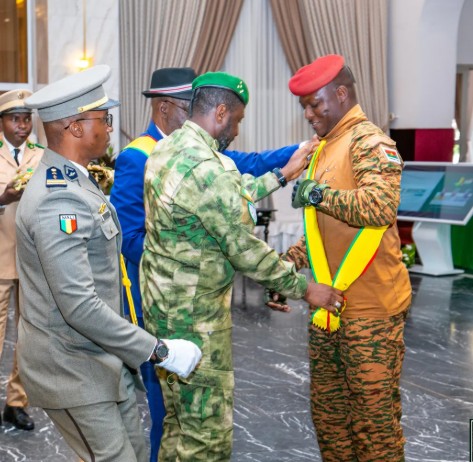
Burkina Faso’s President, Captain Ibrahim Traoré, has taken over the rotating presidency of the Alliance of Sahel States (AES), as leaders of the bloc announced the launch of a joint military battalion aimed at combating terrorism across the volatile Sahel region.
Speaking after being named head of the alliance, Traoré said the deployment of the joint battalion “must be followed by large-scale operations in the coming days,” signaling a more aggressive security posture against militant groups operating across Mali, Burkina Faso, and Niger. He did not provide further details on the scope or timing of the planned operations.
The AES formed by the military-led governments of Mali, Burkina Faso, and Niger—has intensified cooperation following their collective withdrawal earlier this year from the Economic Community of West African States (ECOWAS). The three countries cited disagreements over sanctions, political legitimacy, and regional security strategies as reasons for leaving the bloc.
The launch of the joint battalion was confirmed following a summit of AES leaders this week, where the heads of state agreed to deepen both security and economic coordination. The battalion is intended to conduct cross-border operations against jihadist groups linked to al-Qaeda and the Islamic State, which have carried out deadly attacks across the region for more than a decade.
The Sahel has become one of the world’s most active conflict zones, with insurgent violence displacing millions and undermining state authority. Military governments in all three AES countries have justified their seizures of power by citing the failure of previous civilian administrations and international partners to contain the insurgency.
Analysts say the formation of a joint force marks a significant shift toward regional self-reliance following the reduction or withdrawal of Western military support, particularly from France and other European nations. However, questions remain about the alliance’s operational capacity, funding, and long-term effectiveness in stabilising the region.
No official figures were released regarding the size of the joint battalion or its command structure, though officials indicated further announcements are expected in the coming days.

This strategic alliance shows how regional coordination can address complex security challenges. Similar to how the phdream44 online casino industry adapts through collaborative frameworks, cross-border cooperation strengthens collective resilience. The joint battalion approach demonstrates effective resource pooling for shared security objectives.
Regional security alliances require the same strategic coordination and unified operations that drive successful esports ecosystems. The joint battalion approach reflects how cross-border collaboration achieves objectives through synchronized effort and real-time tactical adaptation. okfun ph exemplifies this integrated coordination model.